


By Greg Vaughn, DCA-749
This is written for those who would like to edit your MAAM R4D-6/DC-3's AIRCRAFT.CFG file in order to make the performance more realistic. The default AIRCRAFT.CFG settings for this aircraft do not add any additional weight for crew, passengers, or cargo. With the modified settings, the aircraft will have a heavier feel to it when fully loaded and your climb time will be slower and more realistic depending on your load.
The first step is making sure that you're modifying the correct AIRCRAFT.CFG file. For example, on my system (which could differ from yours), I have the following three folders under my "aircraft" folder in FS2002:
Since I usually fly the DC-3 that's in DCA livery but uses the original R4D panel, I modified the AIRCRAFT.CFG file that was in my "N1776" folder.
What you'll need to do is modify the AIRCRAFT.CFG file from the DC-3 you're flying in order for the modifications to work. If in doubt which one you're using, just modify all three AIRCRAFT.CFG files after making a backup of the originals ("all three" - assuming you have the MAAM R4D-6 installed).
Here's how (please read through all steps below completely before you start) ...
1) Find the correct folder in your FS2002's "Aircraft" folder for the aircraft you want to modify. The default location is C:\PROGRAM FILES\MICROSOFT GAMES\FS2002\AIRCRAFT\
2) You should see a file called "AIRCRAFT.CFG".
IMPORTANT - First, make a copy of this file as a backup. To make a backup:3) Open the "AIRCRAFT.CFG" file in Windows Notepad. To do so, alternate-click on the AIRCRAFT.CFG file and choose either "Open" or "Open With" to bring up the file. If your only option is "Open With", then scroll down the list of programs and choose "Notepad" then OK.
4) Once the file is open, you'll see that it's divided into several sections designated by brackets. The only section we want to modify is the one called [WEIGHT_AND_BALANCE]
5) Your default section will look something like this:
[WEIGHT_AND_BALANCE]6) You want to replace the lines under the [WEIGHT_AND_BALANCE] line with the modified values such as those from my reference settings below ("remarks" are designated by double forward slashes "//" and won't effect the file. The main lines that need to be included are in bold type). Here's what my reference [WEIGHT_AND_BALANCE] section looks like:
[WEIGHT_AND_BALANCE]7) Once these values are replaced, save the file and reload that aircraft in FS2002.
8) IMPORTANT! Modify the AIRCRAFT.CFG file for each of the other aircraft and do not simply copy the same AIRCRAFT.CFG file to each aircraft folder. There are some lines unique to each variation (i.e. don't copy the R4D file over your DCA file).
EXPLANATION
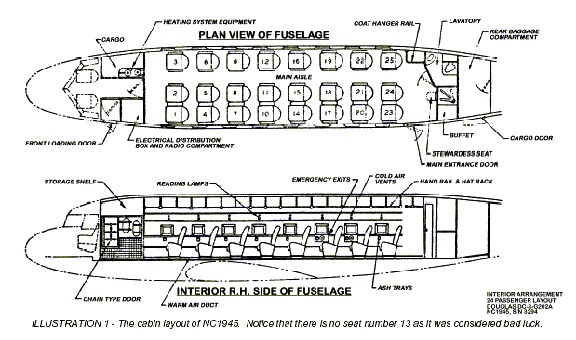
My reference weight and balance settings are based on the DC-3-G202A that I'm restoring which is NC1945 (currently registered as N1945), s/n 3294 (see ILLUSTRATION 1). This is a 24 passenger, eight-window DC-3 that was in service with TWA from 1941 until 1952 and one of the few that never saw military service. The "standard" DC-3 layout is the 21 passenger, seven-window variation. My modifications to the weight and balance apply to both versions (see below). The 24 passenger version simply added an additional row of seats and windows towards the front of the cabin. For additional information on NC1945, please visit my website: www.airlinehistorymuseum.com. While you're there, be sure to also check out our Lockheed 1049G Super Constellation and Martin 4O4.
Each "station_load" line represents a row of seats in the aircraft (see ILLUSTRATION 2). My reference DC-3 has eight rows with three across seating (2+1 config). The average passenger weight used in most airline W&B sheets is 170 lbs., plus 30 lbs. for luggage (some use 130 lbs. for the Stewardess). This means each row has 510 lbs. of passenger weight (170 lbs. x 3). The luggage weight is added to the cargo area (30 lbs. x 3). I have eight rows, each row weighs 510 lbs., plus the crew weight (510 lbs.), which gives me a total passenger load of 4,590lbs. The total luggage (cargo) weight is 810lbs (27 crew & passengers x 30 lbs. each). The front cargo area can only hold 200 lbs. and the remaining 610 lbs. Of cargo is stored in the rear.
The total passenger and cargo weight is 5,400 pounds. Add this to the empty weight of the DC-3 which is 19,068 lbs. and you get 24,468 pounds. Now, subtract 24,468 lbs. from the 26,900 pounds of maximum gross weight allowed in the DC-3 and you then have 2,432 lbs. available for fuel. This should be just over 400 gallons of fuel, or, two full tanks.
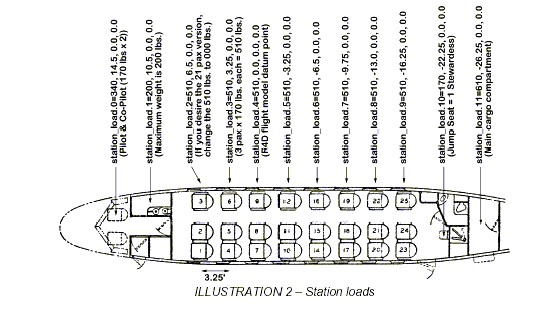
If you wanted to modify this for a seven row, 21 passenger DC-3, then you would zero out the weight in the "station_load.2" line. The line would then be "station_load.2=000, 6.5, 0.0, 0.0".
If you chose to use four across seating, then each station load line might look something like "station_load.x=680, 6.5, 0.0, 0.0" (4 passengers x 170 lbs. each = 680 lbs.).
You'll need to be careful that you don't add too many passengers or cargo as this will further limit the amount of fuel you can load. I'm aware of many military cargo flights in the DC-3/C-47 that were drastically overloaded. In some cases, the wings were so flexed from the weight, the gear wouldn't retract. This made for a very dangerous situation in which you had to run the engines at full throttle well beyond the five-minute time limit at the risk of shelling and engine, just to maintain altitude. The only way to retract the gear was to hopefully gain enough altitude and put the aircraft into a dive, which would unload the wings. Try that with a load of passengers! Regardless, the DC-3 is a very forgiving aircraft.
Over 13,000 DC-3s, C-47s, R4Ds, Li-2s and L-2D were built and there were numerous variations in the seating arrangements. My example is just one of the many variations used but the 2+1 arrangement seems to have been the most popular in the United States. I personally don't know of any DC-3 that was certified to carry more than 36 souls on board but I wouldn't be surprised if there was one out there.
One other thing I'd like to make clear. I'm writing this strictly with FS2002 in mind. I'm not sure how this would translate for FS98, FS2000, or even FS2004.
I hope this helps you to understand how to modify your weight and balance section without getting too complicated or confusing you further.
Happy Flying!
Greg Vaughn
prop-nut@propliners.com
DCA-749
Created March 8, 2003