The MacRobertson Air Race, 1934
England to Australia
The Fourth Day
The End
The KLM DC-2 was well overdue in Melbourne. News reached Holland, and there people gathered outside the KLM office, refusing to leave until they knew "Uiver" was safe.
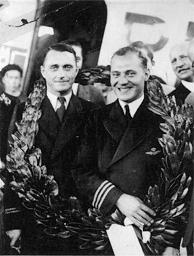
KLM's DC-2 crew hailed as heroes.
The DC-2 was safely on the ground at Albury, NSW. On the morning of October
24th, Parmentier found its wheels were sinking into the rain-soaked ground.
Once more, Albury turned out to help the Dutch, some citizens hauling on
ropes to free "Uiver" while others laid a runway of planks. Parmentier got
the aircraft up, but he left behind two crew, three passengers and the mail,
to carry on by rail.
Roscoe Turner's hope of passing "Uiver" was gone when his engines once more forced him to land, 40 miles short of Melbourne. The Dutch were second to finish, with Turner two and a half hours behind them. The DC-2 team had entered both the speed and handicap sections, but could claim only one prize. They chose to be first in the handicap section, leaving second prize in the speed section to Roscoe Turner's Boeing.
The following day, 25th of October, the remaining DH.88 Comet, G-ACSR, flown by Cathcart-Jones and Waller finished. Five more followed over the next ten days – MacGregor and Walker in the Miles Hawk, the Stodarts in the Airspeed Courier, solo Australian "Jimmy" Melrose in his Puss Moth, the Danes in the Desoutter, the Dragon Rapide of the New Zealand entrants.
Roscoe Turner's hope of passing "Uiver" was gone when his engines once more forced him to land, 40 miles short of Melbourne. The Dutch were second to finish, with Turner two and a half hours behind them. The DC-2 team had entered both the speed and handicap sections, but could claim only one prize. They chose to be first in the handicap section, leaving second prize in the speed section to Roscoe Turner's Boeing.
The following day, 25th of October, the remaining DH.88 Comet, G-ACSR, flown by Cathcart-Jones and Waller finished. Five more followed over the next ten days – MacGregor and Walker in the Miles Hawk, the Stodarts in the Airspeed Courier, solo Australian "Jimmy" Melrose in his Puss Moth, the Danes in the Desoutter, the Dragon Rapide of the New Zealand entrants.
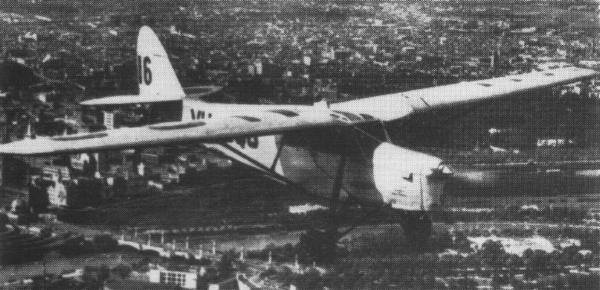
C.J. Melrose's DH.80 Moth VH-UQO
Britain and Australia were both satisfied with the outright British victory
in the speed section, and champions of aviation as a means of international
travel declared themselves vindicated. The victorious red Comet toured
Australia before returning to England. When they returned to Holland,
Parmentier's crew – and his passengers – were heroes. Failing to achieve a
first was not too discouraging to U.S. supporters, since the second
aircraft, and the handicap winner, were both flying American-powered
transport machines.